Another great book review by Brooke Nelson. I have read Dan Brown’s Angels and Demons. Although there is definitely a necessary leap of faith for the reader in this book.
Now that I’m thinking about it, I’m pretty sure the first time I read this book, I didn’t read the entire thing. It’s an odd thought, because now, I would absolutely never DNF this, but I guess that just speaks to how tastes change over the years.
As of today,Angels and Demonsis easily one of my favorite books. The constant action and simplistic writing style blend together perfectly into a fascinating story of non-stop questions and clues.
The characters felt real, and I connected with many of them, whether that be through their personality, their work, or some other trait. The story was written in such a way that I never wanted to stop reading. (I think I read it faster than I’ve read a book in a long time.)
The writing style is straightforward. Extra fluff is never used to add to the word count…
Book Review of Chris Hadfield’s: The Apollo Murders
By Dan Watt
The Apollo Murders is fiction, sort of. As with writer’s such as Tom Clancy (Red October), Clive Cussler (numerous books with his recurring hero Dirk Pitt) and other writers of non-fiction and fiction, Hadfield’s new book is full of real information.
As the crew of the Apollo 18 are preparing to visit the moon during the Cold War era, an additional task is added onto their already complex mission. In order to complete their new task the crew must be ready within a given time. Then a terrible accident occurs that creates even more stress.
Hadfield, a Canadian was a fighter pilot in the United States before becoming an astronaut. He also trained in Russia where he went into space with cosmonauts. So he has real insight into how both space programs work. He also has an interesting perspective on both countries politics during the late 1960s and early 1970s when Nixon was president and Brezhnev was First Secretary.
Many of the characters in his book are real people. Those he created are likely based on people he has known or a conglomeration of their characteristics. Each character has their own nuances that make them feel real. Whether the characters are American or Russian we get their personal view of why they behave the way the do. Who’s right or wrong, good or bad is a matter of perspective.
This is a great read for anyone who likes the turns and twists of a murder mystery while learning about the life of an astronaut and how space ships worked in the Cold War Era.
There are leaps of faith in places but that’s what we expect in fiction. Most of us want to be engrossed in the story while learning interesting facts. Hadfield has successfully filled both needs.
Enola Holmes has a great deal to offer: smart writing, excellent cast, and wonderful visuals and presentations of Victorian life.
Enola (Millie Bobby Brown) is the sister of Sherlock (Henry Cavill) and Mycroft Holmes (Sam Claflin). The story begins with the disappearance of the sibling’s mother Eudoria Holmes (Helena Bonham Carter).
By searching for her mother Enola takes on a journey of understanding. We, as viewers, will see through her perspective, what Victorian England’s attitude was towards women, and learn about class distinction. To lighten things up Enola often breaks the fourth wall to talk to us conversely in a tongue-in-cheek, wink-of-the-eye manner.
As the story progresses we see Enola evolve into a female version that is more akin to her older brother Sherlock, and less like her eldest brother Mycroft.
I would say the whole family can watch this movie, though some eye covering might be needed for the really young during one scene of violence.
An interesting side note: Not only does Millie Bobby Brown demonstrate her acting chops here but she and her sister Paige are also producers. #EnolaHolmes #Moviereview #MillieBobbyBrown #HelenaBonhamCarter #Familyviewing
Usually when we talk about children -the conversations I’ve witnessed and experienced, anyway- we tend to focus on all we do for them. But I think what they do for us is a miracle as well. There are two particular children in my life whom I love very much. One of them seems to have gravitated towards me and always looks forward to my visits. In fact, at a very low point in my life, when no adult would have wanted to be me, I remember her saying, “When I grow up, I want to be like Mommy Tebo.” Not because of anything I owned materially or any accolades I had earned but because of the humanity she had seen in me: the good side that can’t be quantified. It remains the best thing anyone has ever done for me and reminded me that it is worth it to someone
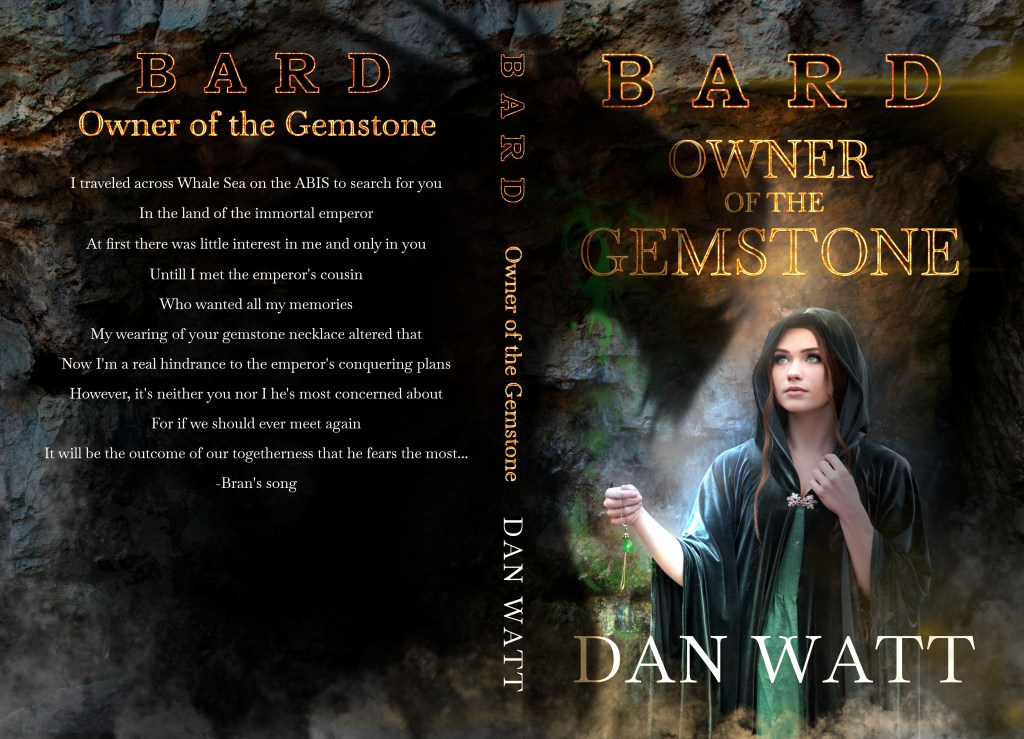
REVIEW: Four stars. BARD is a dark fantasy tale of a young man’s quest to return a gemstone to a girl he saved from ghouls. Along the way, as Bran studies to become a bard, he encounters terrible dangers as he enters the land of the immortal emperor. With war looming, Bran attempts to return the gemstone, while trying to become a Bard Master. Along the way, he both discovers and loses friends, encounters all manner of odd creatures, dark magics, and is forced to confront both his own bias and fears. All the while, he never gives up on his search for the girl who has stolen his heart. Dan Watt’s novel is a fantasy tale with a raw dark fairy-tale feel to it, which I very much enjoyed, and it contains some beautiful lyrical interludes. After all, it is the story of a bard. It is told in the present tense, which gives the story a sense of imminence, and which I found captivating. I was reading David Gemmell, but set it aside once BARD got hold of me. This is a unique world filled with a plethora of fantastical and wonderful characters from demons to elves, dwarves, goblins and orcs, warlocks, and dark experiments gone very wrong. Throughout it all, is the ever-looming presence of an immortal and insane emperor, and perhaps some secrets, which are best left undiscovered. A very enjoyable read, which I highly recommend.
By Darren Joy, author of A Viral Imperium and A Malignant Fetch from his Plagueborn series
However, this is about a book published eleven years ago by Daw Books, Inc. called:
WHO FEARS DEATH
Okorafor’s description of sand reminded me of Barry Lopez’s description of the many types of snow and ice in his Arctic Dreams (Vintage Publ. 1986, 2001). Always shifting and changing. Something to hide within during the night, or run from when the wind is so strong the granules tear gashes like tiny knives.
Her writing felt so real it brought back memories of reading Elenore Smith Bowen and Laura Bohannan’s: Return to Laughter: An Anthropological Novel (Knopf Doubleday Publishing Group, 1965). Both Return to Laughter and Okorafor’s: Who Fears Death creates natural interactions that could happen anywhere in the world. Throughout Who Fears Death, Okorafor deals with the very real emotions of desire, fear, jealousy, and misunderstanding.
Where Okorafor’s Who Fears Death becomes more mythological is her use of JuJu for both violence and healing and her very realistic description of physical transformation.
The main character is written in first person. Her name is Onyesonwa, a girl born of rape between a Nuru and Okeke. The child of a Nuru and Okeke is called an Ewu. Here, Okorafor includes in her narrative, the conversation of how humans treat children of rape, and biases based on appearance and gender that can lead to slavery, war, and perhaps genocide.
Eventually Onyesonwa will head into the desert to fulfill what she believes is her destiny with a group of friends. While journeying through the desert, we as readers, will learn that camels and other creatures are much wiser than most of us realize.
The natural way Okorafor writes the spiritual connection both the Nuru and Okeke have to the goddess Ani; her use of ju ju; and the connection Onyesonwa has with the animal kingdom in such a clear way, has me wondering. Did she sleep to wake in the Wilderness, and upon returning, remember what happened?
This is a story that will pull you in so that the soles of your feet press against the warm sand. You will feel, hear, and smell what Onyesonwu and the other main characters do; until the very end.
I won’t say more because I want you to experience Nnedi Okorafor’s: Who Fears Death for yourself.
An Interview with Laura Suen, CEO of Fire and Steel
By Dan Watt
Laura Suen of FireandSteel.ca and FireandSteel.com
I met Laura Suen, CEO of Fire and Steel, at the 2018 Kitchener Comic Con. She was extremely busy but gracious enough to let me take a few pictures. I’ve wanted to interview her ever since…
Where did the creative idea to start Fire and Steel come from?
Well firstly, I always loved geeky things! My family didn’t have that much money growing up, so I remember taking so long to save up to go to Fan Expo – a comic convention — as soon as I could afford it.
My older sister is a huge geek and I really looked up to her as a kid. We would spend so much time gaming, reading fantasy novels, and watching sci fi TV shows. I of course was the generation that was raised on Saturday morning cartoons too, which included a lot of Japanese anime. Personally I also loved martial arts and do kung fu on the side, so Fire and Steel was just the perfect way to combine my love of martial arts with geeky things.
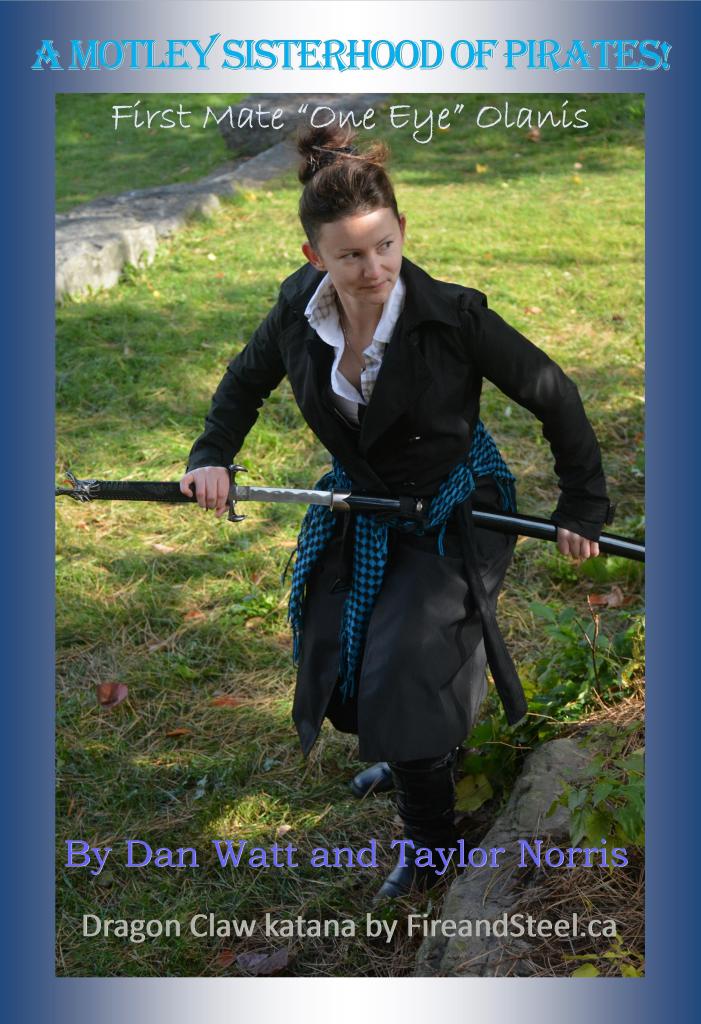
For legal reasons I can only use weapons designed or created by Fire and Steel on covers, such as the one for the weekly blogged story A Motley Sisterhood Of Pirates! However, Fire and Steel has a large assortment of weapons from a variety of styles and sources. Could you tell us about Fire and Steel’s own weapons?
So I use to work as a physicist and from that, I learned how to 3D model. It’s funny how programs that would be used to design laser ion traps can be used to design swords too. Not everything we carry is modelled by myself of course, but there are a few things that we’ve designed in house! I feel so honoured you’ve featured several of them on your book covers.
Dragon Claw katana, exclusive FireandSteel.ca
Medieval Rapier, exclusive FireandSteel.ca
Beginners Ninjato and throwing knives
exclusive FireandSteel.ca weapon
Fire and Steel has all sorts of weapons including ones we see in cosplay, magna, comics, TV shows, movies, and traditional. Could you talk about the Japanese katana?
We sell Japanese katanas of all types and quality levels, so we hope you will be able to find something that suits your needs! We sell wooden training swords called bokken and bamboo practice swords called shinai. These are traditionally used to train with and you’ll see those items showing up in anime all the time. From there, we have carbon steel katanas, which can take some light impact but are more made for display purposes because it is a softer blade. Beyond that, we also carry high carbon steel katanas, which are typically sharp (battle ready) in several different grades. The higher the number, the harder the blade. These blades can typically take a lot of impact and are what you see in a lot of our “Will It Cut” YouTube videos.
I was watching some of the video clips on Instagram and Facebook and saw something very intriguing.
You have the exact same weapons in different grades from metal to foam. This would be perfect for making a movie or TV show. Have any of your weapons been used in movies or TV shows?
Yes! Actually I’m so honoured to say you can see some of our stuff in the background of shows like American Vandals, In the Dark, The 100 and Power Rangers just to name a few.
Your foam weapons look like they’re made of metal. Great for cosplay, LARP, or if a young person wants one of the weapons. Could you tell us more about the foam weapons and their uses?
Foam weapons are great as safer alternatives for people who want to train with swords but don’t want to hurt themselves. In addition, they’re great for cosplay since many conventions and festivals, for safety reasons, do not allow steel swords to be carried around as a part of a costume, even if they’re blunted. For this reason, many people see foam as a great alternative and it saves people a lot of time since you don’t have to make your own sword anymore for your outfit!
Fire and Steel can also design specific weapons for customers. How would a customer go about ordering one of these weapons?
We do take custom requests normally, but COVID has thrown a bit of wrench in schedules and timelines. Please feel free to send us an email at support@fireandsteel.ca for a quote if you want something made – but who knows? We might already have it made and you don’t even realize it!
Fire and Steel is on Facebook, Instagram, and YouTube. Are there are any other links you want to mention?
Our social media handle is @RealFireNSteel for TikTok, YouTube, Instagram, Twitter and Facebook. We also are active on TikTok as @RealFireandSteel too! Find us there. Also of course, check out our website for updates:











 Caedar Writing & Artwork