The Reason I Wrote:  Healing the Temple of the Soul (a story about body image and eating disorders)

The Reason I Wrote:  Healing the Temple of the Soul

(A story about body image and eating disorders)

By D. Watt, B.A., PT

I remember volunteering at a YMCA when a very thin girl came up to me.  She grabbed the skin of her arm and asked me how she could lose fat.  I could see her bone through her skin.  I knew very little about eating disorders then so I told her she didn’t need to lose fat but needed to add muscle.

On TV there would be fashion shows.  I expected to see eye appealing curves and femininity.  What I saw instead was skin and bone; androgynous wraiths wearing clothing that hung on their emaciated bodies.   

Initially I didn’t find many books about girls with eating disorders so I wrote a book about a girl struggling with an eating disorder and body image.  Knowing, that as a male, I could only take what I had heard, seen, and read and bounce it back to create the main character Cynthia, I decided to ask women I knew to read it.  It was strange to have women who had and were dealing with an eating disorder tell me I was on track while professionals who worked with individuals with eating disorders told me I was far off track.

Over the years I did find some books on eating disorders.  The one that stayed with me is Joan Ryan’s Little Girls In Pretty Boxes.  Ryan did research on female gymnasts and figure skaters and interviewed some of the athletes.  After mentioning the book to women I knew or trained my view of what causes eating disorders and body image struggles altered greatly.  Up to that point I had thought eating disorders were only a symptom of trying to control body weight and appearance.  I was shocked when I was told that much of it is caused because of physical, psychological, or/and sexual abuse at a young age.  Healing the Temple of the Soul deals more with the need to belong, attention, and sports.       

A client told me about a model friend of hers who was giving a seminar on modeling.  This was another eye opener.  Programs like Photoshop allow editors to completely change the physical attributes of a model.  A size three can become a size zero, facial features like freckles can be removed, bosoms can be enlarged or shrunk, and the neck and waist can be made thinner.  I am not a fan of what I would call the “mannequin” look. 

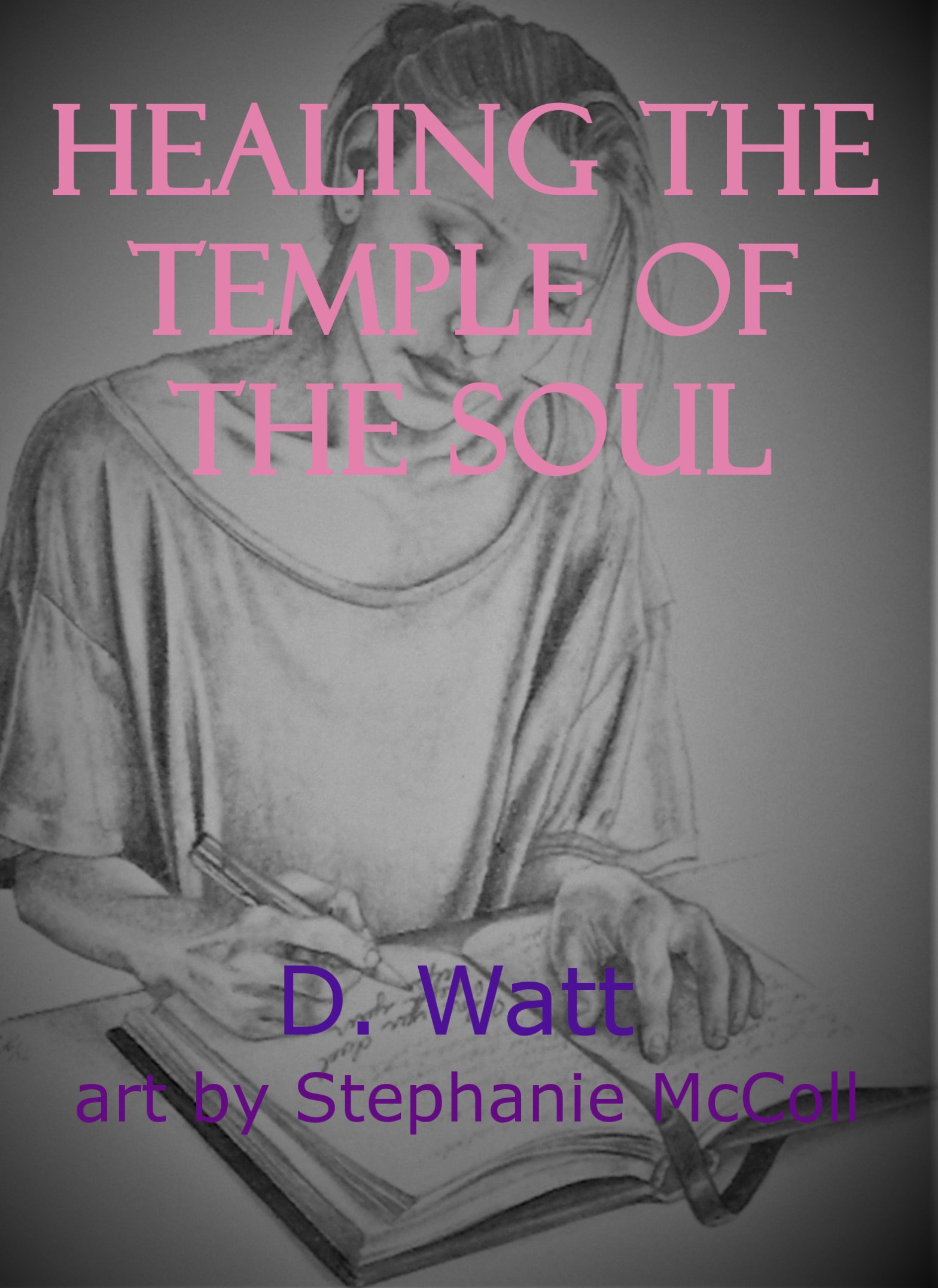
I wanted the cover to represent a scene in the book so I asked my Goddaughter to model for the cover of Healing the Temple of the Soul.  She looked healthy and vibrant in the picture so Stephanie McColl did an amazing pointillism portrait of her looking gaunt.

There’s a song I include in the book by Alanis Morissette called Mary Jane.  A verse in the song says what so many people who care are:

I hear you’re losing weight again Mary Jane
Do you ever wonder who you’re losing it for

Arcade Fire’s Creature Comfort points out the need for attention:

Some girls hate their bodies
Stand in the mirror and wait for the feedback

Now there’s a new song/message from Billie Eilish called Not My Responsibility in which she deals directly with body image and weight:

Is my value based only on your perception?

Or is your opinion of me?

Not my responsibility

Body shaming can come in many forms: too heavy, too light, showing too much skin, or not enough.  Sexual attraction is natural but it needs to be surrounded by respect.  The movie The Fifth Element comes to mind when discussing sexuality and respect.  Bruce Willis’s character Korben reaches out to touch a mostly naked Leeloo played by Milla Jorovich.  Leeloo grabs Korben in a strangle hold and tells him, “Never without my permission.”

The goal of Healing the Garden of the Body is to encourage anyone with an eating disorder or body image struggle that they can overcome their fears.                                                                                                                                                                                                I also wanted to point out that everyone has struggles and the importance of support.  Mostly though, I want people who are struggling to understand that there are others who care about them, including men.

A Review of the epic fantasy novel BARD at Reedsy

Any feedback or questions are welcome.

https://reedsy.com/discovery/book/bard-dan-watt#review

You can read excerpts from BARD at: https://caedar-writing-artwork.com/books/bard/

Chef Gordon Ramsay’s “Hell’s Kitchen” and the importance of Communication, Teamwork, Praise, and Leadership that Earns Respect

Chef Gordon Ramsay’s “Hell’s Kitchen” and the importance of

Communication, Teamwork, Praise, and Leadership that Earns Respect

By Dan Watt, Fitness Trainer and Author

For years I had heard about Hell’s Kitchen and seen Gordon Ramsay on talk shows.  I didn’t really pay attention until became available on Prime Video.  I decided to see what it was all about. 

As I started watching Season One of Hell’s Kitchen my impression was that Chef Ramsay, who once played professional soccer, is one of those male soccer players who crumble to the ground, fakes being hurt and cries as he points an accusing finger at the other team.  I noticed he was allowed to swear at the contestants but if they swore back they were chastised.  It didn’t seem he understood if you dish it out you have to be able to take it. 

His attitude was also similar to how I imagine a captain of an ancient galleon would behave: terrible and all powerful.   As I continued to watch Season One and other seasons I realized the bathrooms must have a lot of liquid soap for Chef Ramsay and the contestants.  If I owned a swear jar on the show I would be very rich right now.  However, it’s better to relieve tension by getting it out by swearing than holding it in and exploding in violence.  The contestants get to express their true thoughts and feeling in separate interviews, suggesting Chef Ramsay isn’t afraid to be criticized outside of the kitchen.

The winning teams are always rewarded with amazing prizes that include visiting restaurants, helicopter and plane rides, and numerous activities, such as surfing.  Chef Ramsay becomes Gordon outside of Hell’s Kitchen and a much more enjoyable person to be around.  The prizes have at least two important purposes.  See what fun you can have if you work hard and succeed, and an introduction to fine dining with the introduction of wine and food tasting.  A good palate is extremely important to Chef Ramsay when he’s looking for a chef to run a restaurant.

Chef Ramsay also educates the contestants (and the viewer if they pay attention) by demonstrating how to make different dishes, such as crêpes.  He also shows his love and respect of the cooking industry by bringing in guest chefs to judge the food, and food critics to be included during dinner services.  Fire fighters, military personnel, kids and others are invited to breakfast or lunch, and in some of the shows, food trucks are used to serve construction workers.  There’s an interesting point made about what foods to serve; knowing your customers preferences leads to better sales and customer returns.  Type of work, what city, and time of day all can have a bearing on a customer’s food preferences.

For those who choose to look beyond the drama there is a great deal to learn watching Hell’s Kitchen.  As Chef Ramsay says in one episode, great chefs are imaginative, think on their feet, and understand the importance of combination, execution, and marriage of foods.  Using that knowledge they are also willing to take chances.

The importance of having a good palate and tasting food to make sure it’s the right food being served is drilled in constantly. 

Chef Ramsay has contestants wear blindfolds and headphones than gives them a variety of foods to taste in a competition between teams.  The point is a chef must have a great palate and be able to taste the differences between foods such as beef and chicken, and distinguish one cheese from another.

The contestants need to work as a team to prepare a plate of food properly.  That means calling out cooking times constantly to each other.  The contestants need to know how long it takes to cook chicken, beef, and pork to perfection compared to how long it takes to cook potatoes, broccoli, and garnishes properly so all of it can be served at the same time.

As a dreaded vegetarian I greatly appreciate that Chef Ramsay demands certain foods are not cooked together.  He also makes it clear mixing foods can be a health issue because of potential food allergies.  If food isn’t cooked correctly he’ll call the contestants up and tell them in the most colourful language why it isn’t.  If the contestants can ignore the yelling and name calling they’ll learn a tremendous amount about proper food preparation.

I also appreciate that he has contestants who lose a competition sort out recyclable food waste from non-recyclable and makes them aware of how much food is wasted when it can’t be served because it’s under or over cooked.

His decisions don’t seem to be based on who is the most experienced but on other qualities.  I second guessed whose jacket he would take and tell to leave Hell’s Kitchen until I started to notice a pattern.  He’s looking for who improves the most, who has the best palate, who works the best with others, who shows the greatest leadership qualities, and who shows the most passion to succeed.

The show is a reminder that during busy times there isn’t always time for niceties.  Minds are racing to remember orders, and how long to cook food at what temperature in unison with the other cooks’ preparations.  Hearts are pounding with exertion to get the orders delivered on time.  However, it’s also imperative to commend those who do a good job, show improvement, and to let go of anger and frustration once the orders are done.  The swearing is for effect on the TV Show.  Swear words will escape out of frustration or exhilaration but should be avoided using towards another individual.  However, it’s better than bottling up to let out as violence towards someone else, especially an innocent bystander.

The four vital factors I’ve been reminded of by Chef Gordon Ramsay’s Hell’s Kitchen are: communication, teamwork, praise when deserved, and a leadership quality that earns respect.

Stay Strong and Stay Safe!

D.W.

Morning Always Comes: Grace MacGowan Cooke

Morning Always Comes

Grace MacGowan Cooke

There has never been a night so long and dark and fearsome but at last it came to an end.  A smiling, laughing sun is for ever creeping up to the ridge of some hill to bid a hopeful good morning to a weary-from-watching world.

The surest thing in the world is sun-shine.  It rolls away the darkness, dissipates the fog, and makes crystals of joy shine in the melting tears of night.

Morning always comes.  That is a good thought for any time, but it is a particularly consoling thought when your heart is heavy, and you imagine that you are carrying more than your share of the burdens of life.  If we would only be as sure of the other things in life as we are of the return of the sunshine, it would make it much easier, especially for those whose faith in the goodness of things is not sufficiently strong to enable them to smile.

Morning always comes.  Don’t be down-hearted.  Set your alarum, and get up and greet it with a smile.

Grace MacGowan Cooke’s Morning Always Comes “The Girl’s Own Annual” p. 29

  • The book is signed: To Eva From Father & Mother 1918

(Eva was known as Nanny, our father’s mother)

I grabbed an old looking book for a picture to use in a story.  Out of curiosity I started flipping through the pages and came across Grace MacGowan Cooke’s Morning Always Comes.  A needed reminder for these times.

 Grace MacGowan Cooke was born Sept. 11 1863.  She and her sister Alice MacGowan collaborated on numerous books and short stories. Although this poem was published more than 100 years ago I consider it the property of the MacGowan Cooke’s family.

Book Review of Barak Obama’s “A Promised Land”

Book Review of Barak Obama’s “A Promised Land”

By Dan Watt, B.A. Anthropology and History, W.L.U.

“Here’s the thing,” I would say.  “Most people, wherever they’re from whatever they look like, are looking for the same thing. They’re not trying to get filthy rich.  They don’t expect someone else to do what they can do for themselves.

“But they do expect that if they’re willing to work, they should be able to find a job that supports a family.  They expect that they shouldn’t go bankrupt just because they get sick.  They expect that their kids should be able to get a good education, one that prepares them for this new economy, and they should be able to afford college if they’ve put in the effort.  They want to be safe, from criminals or terrorists.  And they figure that after a lifetime of work, they should be able to retire with dignity and respect.”  – Barak Obama (p. 48)

A Promised Land is an insightful autobiography of national and international politics that gives you a front row seat to what it’s like to be a political leader.  Obama describes where his values came from and his evolution as a person and politician.  He doesn’t claim everything he did succeeded but he does demonstrate how his team did the best they could under the circumstances.  He gives examples of what his goals were and the necessity to often make compromises to reach those goals. 

The book is in chronological order with historical inserts of social, political, environmental, military, and economic history to help the reader understand why certain events like the economic crash in 2008 happened, and why the war in Afghanistan continued.

Throughout A Promised Land Obama refers to the influences his mother, Ann Dunham, and his maternal grandmother, Madelyn Lee Payne Dunham, had on his belief system. 

When he was a child and his mother found out he had been part of a group teasing another kid his mother sat him down and told him:  “You know, Barry (his nickname), there are people in the world who think only about themselves.  They don’t care what happens to other people so long as they get what they want.  They put other people down to make themselves feel important.  Then there are people who do the opposite, who are able to imagine how others must feel, and make sure that they don’t do things that hurt people.  So, which kind of person do you want to be?”  (6-7)  From his maternal grandmother he learned stoicism:  “She taught me to marry passion with reason, to not get overly excited when life was going well, and to not get too down when it went badly.” (114) 

Obama gives credit to those who helped him along the way.

Such as his Chief of Staff during his early senator days, Pete Rouse, who helped him recruit “a topflight staff”.   (55)  David Axelrod, media consultant (43) and Robert Gibbs, communications director (50) along with a host of others are mentioned throughout the book giving a sense that a democratic leadership is really a ‘We’ government.  

He also talks about how surprise moments drove home his belief in himself and that he could become the next leader of the United States.  In Greenwood, South Carolina, he was preparing to give a speech when he heard Edith Childs shout out: “Fired up!” and the gathering reply with: “Ready to go!”  Obama admits hearing the chant energized him.  The chant became the rallying call throughout his candidacy for the presidency.  (97, 196)  The chant was also a reminder throughout his campaign that he wasn’t just running for the presidency but that upholding belief in the Declaration of Independence still meant something. 

He mentions that “a burly, bearded guy in biker garb and covered with tattoos strode up to me after an event and shoved something into my hand.  It was his lucky metal poker chip…”  As others gave him their tokens or lucky charms he started keeping them in his pocket during speeches.  (p. 190)

Obama demonstrates his willingness to work with individuals in a bipartisan manner and his thankfulness to those who stood up for him when others were attacking his character.

In his junior year as a senator Obama connected with Dick Lugar, a Republican from Indiana and the chair of Foreign Relations Committee.  Lugar and Democratic Senator Sam Nunn were able to pass legislation that allowed America to help the Soviet Union deactivate nuclear warheads.  Lugar invited Obama to travel with him to Russia to see where nuclear weapons were deactivated.  He mentions how Lugar opened his eyes to the difference a senator could really make.  (60-61)  

When Sarah Palin started accusing Obama of “palling around with terrorists who would target their own country” and other false accusations it was John McCain, his Republican competitor for the presidency, who stood up for him.  At a rally in Minnesota McCain told the audience, “I have to tell you, he is a decent person and a person that you do not have to be scared of as president of the United States.”  (195)

Obama lets future leaders know that anything you do in a public place will be made into news.

At the Western Wall in Jerusalem he wrote a prayer on a piece of paper and placed it into the wall.  It was meant as a private message to God but someone dug it out after he departed and gave it to an Israeli newspaper who printed it.  (160)   

Keeping grounded is something Obama truly believes in. 

When Michelle asked her mother Marian Shields Robinson to help take care of the girls and also so she has someone to talk to Obama embraces the idea.  “My mother-in-law didn’t act like she was better than anybody else, so our daughters never even considered that an option.”  (223)

Obama made sure he visited Walter Reed and Bethesda naval hospitals throughout his tenure as president.  Seeing up close what war can do to an individual reminded him to be as sure as he could be, that the decisions he made, were the right ones.  Not all the sons and daughters in the United States military came back alive, and many others that did, didn’t always come home whole.  He mentions visiting a soldier so bandaged up the soldier’s mother had to remind Obama that he and her son had met before.  (576-577)

Obama learned early in life to reverse the roles so he could try to understand another person or groups perspective. 

He demonstrates this often in the book so the reader sees both sides of an argument.  On why the Tea Party seemed such an attraction to working and middle class whites he points out that: “Many of the working- and middle-class whites gravitating to the Tea Party had suffered for decades from sluggish wages, rising costs and the loss of the steady blue-collar work that provided secure retirements.”  (404)

To initiate a program to protect the environment Obama once more demonstrated that getting the job done was his first priority.   

He used the cap-and-trade system initiated by the Republican President George H. W. Bush’s administration in 1990 as a template.  In Obama’s words Bush’s system worked, because “Despite dire predictions that the measure would lead to factory closures and mass layoffs, the offending companies had quickly figured out cost-efficient ways to retrofit their factories, and within a few years, the problem of acid rain had all but disappeared.” (501)

There is so much in this book I have not mentioned.  It took me a long time to read, not because it’s a big book at 700 odd pages but because Obama deals with so many aspects of his personal and political life.  His grandmother and mother’s influence; his love for his wife Michelle and their two girls Sasha and Malia Ann; his gratefulness towards all the hard work the people he collaborated with on his journey to the senate and then the presidency; and how his knowledge of national and world affairs helped him to see from different perspectives that allowed him to negotiate whenever possible but demand if necessary.

This book answered a lot of questions I had about a number of events over the last twenty years.  I still remember watching a meeting Obama was holding at a town on TV.  To paraphrase, I heard him say: This is what people are asking and this how I reply.  I had never heard a leader say that before.  And he did answer.

In conclusion, I would highly recommend this book to anyone interested in taking political science, or simply wanting to learn what leadership should be like.

Interview with Michele Bischof (High Vibe Fitness Coach)

Michele Bischof is a Holistic Health and Fitness coach and self-love guru, boss babe business woman, empowerment and motivational coach, personal growth mentor, and creator of Finally Free transformational program and Resilience Training for Young Girls Program. 

Her mission is to help as many people as possible design and live their life to the truest potential.

Michele in her home gym
  1. We’ve known each other for years and you have always kept yourself in fantastic shape.  I know you were a respiratory therapist and worked for Pfizer in the past.  Now you’re a High Vibe Fitness Coach.  How did your years of exercise, medical knowledge, and focus on nutrition lead you to become a High Vibe Fitness Coach?

I have worked as a Respiratory Therapist for 10 years and then I went into the business aspect of healthcare working as a pharmaceutical sales rep for 15 years.  Currently, I am working as a medical sales rep for Icentia.

In my personal time I enjoy coaching and helping others meet their personal health and wellness goals through my Holistic Fitness business.  My passion for health and wellness is deep rooted and I thrive on helping people.  I want to help others achieve their goals and feel their absolute best so I started my own coaching business.

  • How did you get started in weight training?  You also told me about the Eat Clean Diet which I think Donna O’Quinn originally told you about.

I was feeling like I needed something more and a friend of mine introduced me to Bill Phillips.  I bought the book and got serious about making a personal change and I committed to doing a 12 week challenge.  I had a significant transformation and physical fitness and health became an even more important part of my life.  I lost weight, gained tons of energy, and started to build muscle.  I was hooked.

I took it further to learn more about clean eating and was introduced by a friend (Donna O’Quinn) to Tosca Reno’s Eat Clean Diet.  I followed her meal plans and it took me to a whole new level of being fit.

Holistic Training
  • I know you were in a bad car accident.  Instead of giving up I watched you adapt your program. 

My passion for my work stems from my own healing journey.  After being involved in a car accident in 2014 that severely injured my back, I found my way back to health and wellness using an inside out approach. Tapping into the power of my mind and determination to keep moving, focus on feeling strong and to never give up has led me to not only physically healing my body, but also starting my own business to help others.  My personal experiences have been powerful teachers and in becoming attuned to my body messages, I have healed my body, mind, and soul and I use this approach to help others do the same.  Turning my pain into passion I changed my thought process and adapted my program focusing on core strength and setting small goals for myself along the way.  In doing this, I became strong in my mind and my body.  I overcame huge challenges and I’m stronger today because of it.

  • Your oldest daughter was training to become a paramedic.  How did you help her out to succeed?

My oldest daughter is a paramedic.  Helping her has been one of the most incredible and rewarding experiences of my life!  With my medical knowledge, business background, and love for health and fitness, I offered nutritional guidance and coached Rachel using motivational and mindset techniques to help her prepare for physical fitness testing and interviews. She has since also adopted a very similar healthy living and active lifestyle.

  • All of your kids are in sports, like hockey.  What eating habits and fitness knowledge did you pass onto them so they stay healthy and energetic?

My kids have all been in sports over the years, baseball and hockey and my son also enjoys Kung Fu.  They started at a young age, making it part of their lifestyle.  I believe in educating my kids on the value of taking care of their bodies and minds, being active, and eating well.  My kids understand what a balanced meal is and I teach them that food is fuel and active movement is essential for their wellbeing. Food choices are important and we focus on choosing healthy foods and occasionally eating not so healthy foods. It’s amazing to watch them choose healthy nutritious options on their own.  I’m also a hockey trainer for my youngest daughter’s hockey team.  I encourage active movement and activity with the girls and run a 30-minute virtual dryland training once a week.

  • You now offer coaching and fitness programs for adults and kids.  What age range can work with you and how do you determine their current fitness level?

I work with adults and kids (9 years and up).  I offer 1 on 1 personalized life coaching, customized success plans, customized fitness programs, and nutritional meals.  If a client is interested in a physical fitness program I ask that they talk to their doctor before starting a physical training program if they are new to it.  I assess their level of fitness based on their mobility, flexibility, strength, past experiences, injuries, and current level of fitness.  I also discuss and establish goals and objectives with each person I work with.

  • What are the best ways for people to contact you?

You can find me at:

Website:  www.michelebischof.com (Holistic Fitness – Physical Fitness, Mental Fitness, and Spiritual Fitness)

Facebook: Michele Bischof

Instagram: @_michele_bischof

Email: michelebischof@hotmail.com

Rita Walker: Australia (Blog Sixteen and Conclusion) by Dan Watt and Taylor Norris

Rita Walker: Australia (Blog Sixteen and Conclusion) by Dan Watt and Taylor Norris

Tom Paxton – Whose Garden Was This? (Live 1971)

“It won’t just be the Australian government and businesses that will be watching this conference but also many governments around the globe,” Aurora is saying from the front passenger seat to Rita and Zsofia.

“Do you know Professors Bappy and Jules?” Rita asks.

“Don’t tell me those two blokes are involved,” Oliver says in a voice full of disgust.  “Whatever you do don’t agree to meet either of them for drinks.  Whatever they offer you whether food or drink-wise it’s probably spiked with Ecstasy.”

“They are most certainly are going to be there,” Rita replies with a frustrated sigh.

At the entrance to the University both Aurora and Oliver hug Rita and Zsofia.  “Let us know when you’re done,” Aurora says before she and Oliver drive away.

“I feel like we’re going into a dream or battle,” Zsofia says with her game face on.

“Just a conference,” Rita says in a shaky voice. 

Inside they meet Merindah.  Like them she’s dressed professionally.  Rita notices that Merindah’s clothes are the colours of the University.  A red blouse and blue pants with gold stripes.  “Ready?”  Merindah asks.

“No,” Rita and Zsofia say at the same time then laugh.

Together they walk down the long hallway with the ceiling so high Rita still thinks it’s meant for giants; if not from the past then perhaps the future.

The conference room is modern with a round table at the centre.  Rita sees a number of women and men already seated with folded name cards facing out.  They all have intent stares and wear business suits.  Rita gives a sigh of relief; Iluka is among them.  Directly across from where she and Zsofia are to sit are Professors Bappy and Jules.

“We owe Aurora for the blouses and slacks we’re wearing,” Zsofia whispers to her.

“We owe both her and Oliver a great deal of gratitude,” Rita whispers back.  “And if this works so does the rest of the planet.”  Rita’s blouse is semi-translucent white on purpose.  She wants to make sure the two rainbow snakes are at least partially visible.

“You’re by the globe maker,” Merindah tells them.

“Let us get started,” Professor Bappy says.  “Unlike my cohort Professor Jules I do think we need to be concerned about the environment.”  Rita is intrigued at how smooth Bappy speaks.  “However, I fear the financial cost is too great.”

“That’s why we need governments and businesses to work together,” Rita says. 

“Each country should deal with its own problems,” Professor Jules says with a grumble as he sits with his arms crossed over his chest.    

“On March 11, 2011 an 8.9-magnitude earthquake struck Japan causing a tsunami and affecting around 805 km of its coastline,” Zsofia says.  “Up to eighteen million tonnes of debri from that earthquake was estimated to land on Canada’s west coast by 2014.”

“What does that have to do with today’s meeting?  And remember I’m very educated in environmental issues,” Professor Bappy throws in.

Rita smiles as Zsofia leans forward and says, “That means, what happens in one place effects another place on Earth.  Australia’s use of coal is affecting air, ground and water causing illness and death.”

“Now you’re attacking Australia!  This is nonsense,” Professor Jules shouts out as he stands up and slaps his hands onto the table.

Zsofia leans farther forward.  “We’re in Australia so we should include it,” she replies.

“Plastic is another concern,” Rita says, intentionally changing the subject.

“Are we here to talk about plastic?” Professor Bappy asks sarcastically.

“We’re here to discuss the environment,” Rita replies with a soothing voice.  “Almost all countries are polluting the environment with plastic waste.  Too much of it is entering the ocean creating plastic islands.  Renewable, recyclable, environmental friendly energy and products are needed.”

“Businesses will shut down if governments enforce these changes,” Professor Bappy says in a very paternal voice.

“People will be out of work,” Professor Jules shouts out.

“Absolutely not,” Zsofia says.  “Governments and businesses can work with universities and colleges to make changes smooth and efficient.”

“And cost tax payers an exorbitant amount of money to make these changes,” Professor Jules says with a guffaw.

“The idea of collaborating,” Rita says with more calm than she feels, “is that the transition to environmentally friendly energy and products becomes an easy transition.  Jobs aren’t lost their replaced and healthy individuals think clearer.  Less toxins in the air, ground, and water means less stress on the health system.  For the companies that need assistance for the changeover taxpayers, and such the government, can afford to financially assist.”

“And for businesses that refuse to change?” Professor Jules says with a snarl.

“There will be penalties, perhaps even shut downs,” Zsofia says.  “But the majority of businesses are willing to make changes to make an environmentally friendly Earth.”

“What’s to stop businesses from buying environmentally friendly technology or companies that create the technology and shutting them down?”  It’s the first time Iluka has spoken up.

“Laws need to be implemented to make such happenings illegal,” Zsofia replies.  “Normally a project is non-disclosure until a paper is written.  A special government department should be created, if it hasn’t already, to over-ride non-disclosure deals and stop the destruction of knowledge.”

Rita stands up and turns on the light sabre like device.  A globe of the Earth appears.  She expands it with her hands.  “When it comes to developing environmentally safe energy and products we need to collaborate as a planet, not just individual countries.  We need to share ideas and technologies.  Each environment has its own solutions.  A country’s natural resources should be used to replace coal and plastics and other environmentally damaging products.  In other words there isn’t a single answer but many.”

Back in her room at the University, Rita gathers up the few items that are hers.  Zsofia has gone with Merindah to clean out her room.  Later Zsofia will head back to Canada while she’ll meet up with Marlo.  Her door opens and Professor Bappy and Jules enter.

“No one will heed what you said today Sheila,” Professor Bappy says. 

“They will,” she replies.  She knows that you have to believe in something to make it happen.

“Those symbols on your chest and on your belly won’t save you,” Professor Jules says.  “We’ve corrupted the Dreamtime so it Dilga’s powers will arrive too late.”

Rita sees a familiar tall female figure walk by her open door but the professors don’t seem to notice.  “Shall I call you Bamapana and Julana?” she asks.

“Whatever you want lover,” Julana says with a sneer as he steps closer.

“Do you know what I am?” Rita asks as the colour of her pupils start to change.

Julana takes a step back and bumps into the tall form of Bamapana.

Bamapana starts to open the door wider to escape when he trips over something.

A giant snake the colour of the rainbow slithers over him.

Rita places her hands overhead and presses her palms together.  “Back to the Dreamtime for you,” she says as her body changes.

https://www.nationalgeographic.org/encyclopedia/great-pacific-garbage-patch/

https://ourworldindata.org/plastic-pollution

https://www.cbc.ca/news/world/18-million-tonnes-of-tsunami-debris-drifting-to-b-c-1.992049

Blue Mountain Jenolan Caves background pic by Peter Samuel with Rita Walker body makeup by @amasonart Alannah Mason, model Taylor Norris, picture of model by Dan Watt

Caedar-writing-artwork.com

Mythruin.simplesite.com

Rita Walker: Australia (Blog Fifteen) by Dan Watt and Taylor Norris

“We’re going to present this as something the committee wants to be involved with, not a threat, so it should go over great!”

Rita Walker: Australia (Blog Fifteen) by Dan Watt and Taylor Norris

Ooderoo Noonuccal (November 3, 1920 to September 6, 1993) is an Aboriginal Australian poet.  Here is one link to All One Race and her other poetry:  https://www.poetrylibrary.edu.au/poets/noonuccal-oodgeroo/poems/all-one-race-0719001

Rita sits in her empty classroom at the end of the day and massages her temples.  It’s the fourth week of teaching and none of her clients are elementals or from the Dreamtime.  They’re all interested in sustainability but prefer to debate each other instead of working as a team.  Zsofia steps into her room first.

“Brought you some coffee,” Zsofia says placing the steaming mug on Rita’s desktop.

“I don’t think most of the population cares about recyclable, biodegradable, renewable products or energy,” Rita says with lament and frustration in her voice.  “We have biochemists, and a number of engineers in the class yet most won’t speak up about what to do for the environment.”

“A good manager gets people to work for them willingly,” Zsofia says with a chuckle.  “Take their knowledge and use it to get government and businesses to collaborate.   Today’s going to be rough for you Rita.  We have to discuss what happens if businesses refuse to initiate environmentally focused practices.  Also we need to go over the repercussions to buying out companies with environmentally sustainable technology and then destroying the new technology or making it impossible to use.”

Rita rubs her temples harder.  She takes a long sip of the coffee.  This is what we have so far:  “If we’re talking coal and natural gas the procedure is to invest in multiple technological solutions.  That could be better filtration, adding non CO2 producing biodegradables, and the gradual replacement of coal and natural gas by reusable energy.  As for plastics.  Micro plastics, and plastics in the water and land need to be removed and either stored or re-used.  At the same time biodegradable substitutions should be developed.  It will be important to get replacements from a variety of sources, preferably the parts of plants currently considered waste by-product.  The other reason is a variety of sources means one substitute will not hinder the growth of others.  We don’t want deforestation or the loss of food crops in order to grow one type of plant to use as a plastic substitute.”

“That sums up the technology,” Zsofia says taking a sip of her own coffee.  “What we want to do with businesses is introduce more environmentally friendly substitutes for what they currently have.  The changeover should be financially viable, even if that means the government needs to supplement the business while it starts the changeover.  We also want job security for the current employees.  For businesses who are willing to change there will need to be financial penalties that may lead to forced closure.  We also need to make sure there are government policies that protect environmental technologies from companies purchasing them then refusing to use them or from destroying the technology.”

“Do you think this will get accepted?” Rita asks.  She just wants to get the next two weeks over with now and meet up with Marlo.

“Thank you for being here,” Rita says giving her friend a powerful hug. 

https://www.journals.uchicago.edu/doi/10.1093/reep/rex013

Blue Mountain Jenolan Caves background pic by Peter Samuel with Rita Walker body makeup by @amasonart Alannah Mason, model Taylor Norris, picture of model by Dan Watt

Caedar-writing-artwork.com

Mythruin.simplesite.com

Review of Chris Hadfield’s: An Astronaut’s Guide To Life On Earth

Review of An Astronaut’s Guide To Life On Earth by Chris Hadfield

Although this book has been out since 2013 I only just read it.

I am always looking for a story that is motivational, not because it tells me what I want to hear but because it’s real.  An Astronaut’s Guide To Life On Earth is about perseverance but also to remember your family and friends, even when you’re out in space.

By talking about the lessons he learned to become an astronaut Chris Hadfield makes it clear his wife Helene played a major role in his success.  Helene encouraged him but also grounded him, reminding him of the sacrifices she and their family made, and reminding him to include them.  Throughout the book Chris shows his mistakes, his successes and the absolute importance of being a team player, whether as leader or co-pilot.

One of his major points is being a square trying to fit into a round hole.  His approach to becoming an astronaut was to become an Air Force pilot and mechanical engineer all the while knowing it would be next to impossible to go into space.  What I enjoyed throughout the book was that he constantly learned and went on the basis of that if the square can’t get through the circle, that he doesn’t become an astronaut, he has his pilot and engineering skills to fall back on.  He didn’t put all his eggs into one basket.

He talks about sweating the small stuff.  He points out that as an astronaut, if you don’t sweat the small stuff (haven’t prepared by going over all the finer details) you could kill yourself and your crew mates.

Encouraging others and being encouraged is a theme he mentions continuously.  He talks about the importance of “investing in other people’s success doesn’t just make them more likely to enjoy working with me.  It also improves my own chances of survival and success.”

He makes it clear how important team work is “No astronaut, no matter how brilliant or brave, is a solo act.  Our expertise is the result of the training provided by thousands of experts around the world, and the support provided by thousands of technicians in five different space agencies.”

Singing David Bowie’s Space Oddity on the International Space Station was his son Evan’s idea.  An idea that has a lot of children now interested in space.  As Chris Hadfield mentions in his book, spaceflight isn’t just about looking away from the Earth but at it.  Satellites allow for communication, the ability to study weather and pollution patterns.  To find things that might not otherwise be able to be found such as planes that need to make emergency landings or boats lost at sea. 

In conclusion this is a fantastic book.  I have not added page numbers to the quotes I used because I want you to read the book yourself.